






- Enterprise contract management gives Legal, Procurement, Finance, Sales, and business teams a shared way to manage contracts across entities and functions.
- The strategy starts with governance: clear ownership, approval authority, contract templates, exception rules, and contract data standards.
- Singapore-based regional headquarters need a model that keeps group standards consistent while giving local entities room to handle market-specific requirements.
- A scalable contract management strategy connects governance with workflow, data, technology, automation, and performance measurement.
- Once these rules are in place, a centralised contract workflow can support day-to-day execution. Mekari Sign brings contract management, approval, electronic signing, and document tracking into one platform.
Singapore is a major base for companies managing regional and global operations. The Singapore Economic Development Board (EDB) describes the country as a hub for regional and global headquarters, with companies using Singapore to manage operations and expansion across Asia.
That structure creates a specific challenge for contract teams. A regional headquarters may oversee contracts created by Sales, Procurement, Finance, HR, and Legal across several entities. Each team may also follow different approval routes, use different templates, and work with different systems.
Enterprise contract management brings these activities into a common operating model. The focus is on how contracts move through the business, who owns each decision, which rules apply to each agreement, and where technology can support the process.
What Makes Enterprise Contract Management Different?
Enterprise contract management covers the full contract lifecycle, including intake, drafting, review, approval, signing, storage, monitoring, and renewal.
The enterprise setting adds several layers of responsibility. One group may manage multiple legal entities, business units, contract types, approval levels, and markets at the same time.
The Singapore Department of Statistics recorded 356,100 enterprises in 2024. Non-SMEs represented around 1% of enterprises while contributing 53% of nominal value added. The figures show why a relatively small group of larger businesses can carry substantial operational scale.
| Contract Management Layer | Enterprise Question | Typical Control |
|---|---|---|
| Governance | Who owns the contract and who can approve it? | Policies, delegation of authority, approval thresholds |
| Process | How does each contract type move through the business? | Standard workflows and escalation rules |
| Data | Which contract information needs a common structure? | Metadata and classification standards |
| Technology | Which activities need central control or automation? | Workflow, integrations, access control, reporting |
How Should Enterprises Design the Contract Governance Model?
Governance defines the rules for creating, reviewing, approving, signing, and managing contracts after execution. Good governance also gives teams a clear path for routine agreements and higher-risk exceptions.
Define Ownership by Contract Type and Entity
Each contract needs a clear business owner and legal entity. These details determine who manages the agreement, who can access it, and which team is responsible for follow-up actions.
The Accounting and Corporate Regulatory Authority (ACRA) maintains Singapore’s public register of business entities and provides more than 1.5 million records through its Open Data Initiative. ACRA updates the datasets monthly, which makes entity information useful when building a structured contract database.
For an enterprise group, entity information can sit alongside contract metadata such as contract type, business owner, value, effective date, and expiry date.
Standardise Templates and Approval Authority
Standardisation works best when the business defines approved templates, clauses, approval limits, authorised signatories, and escalation triggers.
A standard procurement agreement, for example, can follow a predefined route. A material change to liability terms can trigger Legal review before the agreement reaches the signing stage.
| Contract Situation | Governance Treatment |
|---|---|
| Approved template with standard terms | Standard workflow |
| Limited changes within approved parameters | Controlled business review |
| Material clause change | Legal review |
| High-value strategic agreement | Senior approval |
| New jurisdiction or unusual legal requirement | Legal review |
Separate Group Standards from Local Requirements
A Singapore regional headquarters can set group standards for areas such as contract metadata, approval authority, access controls, template ownership, risk thresholds, and reporting.
Local entities can then maintain country-specific playbooks for legal requirements, execution practices, and escalation procedures. The result is one group framework with controlled local variations.
This structure also gives headquarters a consistent view of contracts across entities while keeping local teams close to their own requirements.
How Should Singapore Enterprises Manage Cross-Border Contracts?
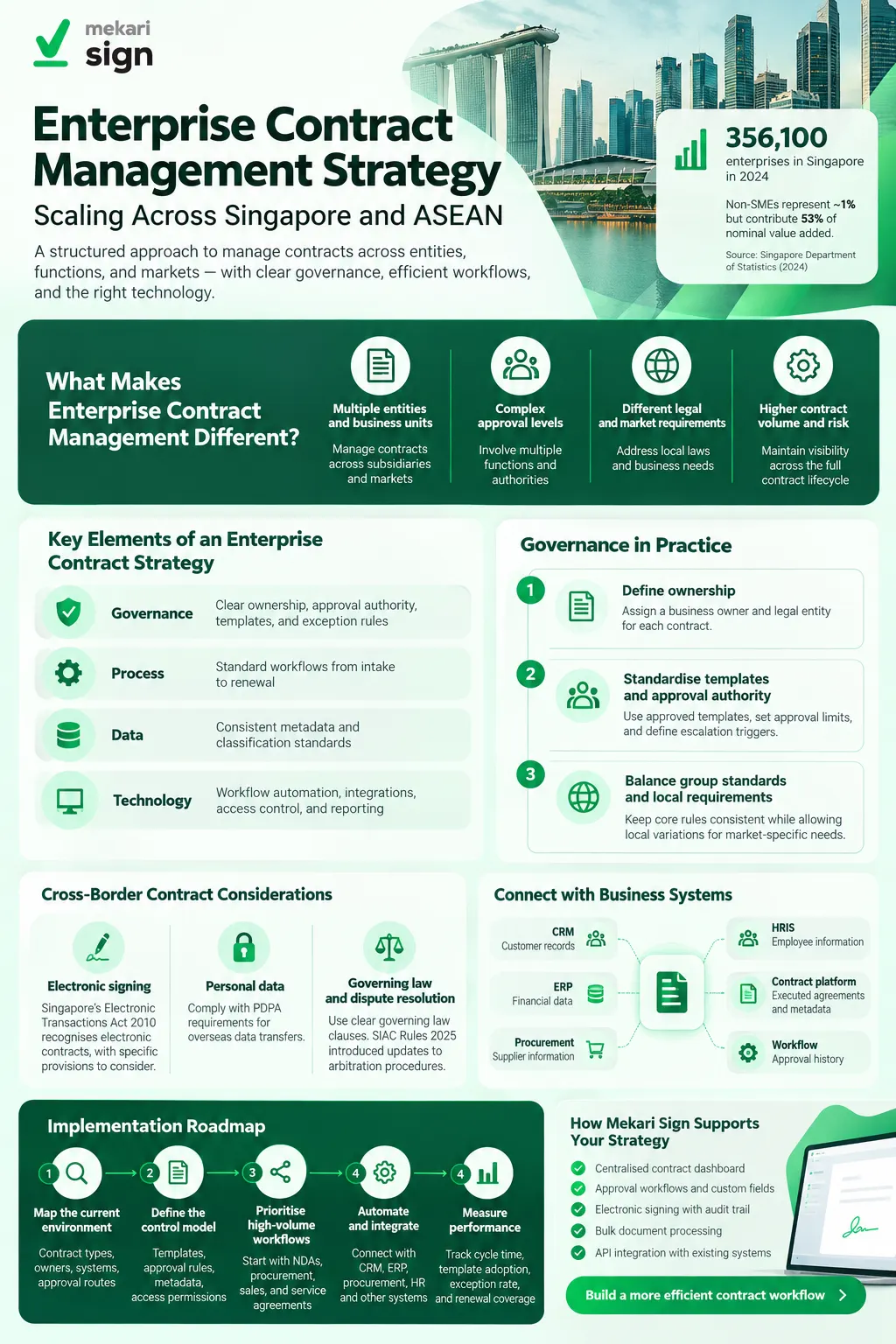
Cross-border contracting brings together several areas of legal and operational control. Contract teams need a clear policy for electronic execution, personal data, governing law, and dispute resolution.
Electronic Signing Policy
Singapore’s Electronic Transactions Act 2010 provides a legal framework for electronic records, electronic signatures, and electronic contracts. Section 11 recognises the use of electronic communications in forming contracts.
The legislation also sets out specific exclusions and requirements for certain transactions. Enterprise signing policies should account for those provisions when teams decide which documents can use electronic execution.
A practical signing policy can define approved signing methods, identity verification requirements, authorised signatories, document exceptions, and Legal escalation points.
For a broader explanation of the signing technology, see what is digital signature.
Personal Data Controls
Enterprise contracts often contain information about customers, employees, suppliers, directors, and signatories. Contract storage and access therefore sit within the wider data protection framework.
The Personal Data Protection Commission (PDPC) sets requirements for overseas transfers of personal data under the PDPA’s Transfer Limitation Obligation.
Contract governance can capture the relevant controls by documenting data location, access rights, overseas transfers, contractual safeguards, and retention rules.
Governing Law and Dispute Resolution
Regional agreements should define governing law and dispute-resolution mechanisms during drafting. These provisions shape the legal process that applies when parties operate in different jurisdictions.
The SIAC Rules 2025 took effect on 1 January 2025 and introduced changes to arbitration procedures, including preliminary determination, coordinated proceedings, and updates to emergency arbitration.
An enterprise can maintain preferred dispute-resolution clauses and set an approval route for agreements that use different terms.
Build a Cross-Border Contract Control Matrix
A jurisdiction matrix gives regional teams one place to record differences across markets. Legal and Compliance teams can use it when they review templates, signing methods, data requirements, and escalation rules.
| Control Area | What the Matrix Should Capture |
|---|---|
| Execution | Accepted signing methods and document formalities |
| Identity | Verification requirements for signatories |
| Data | Storage, transfer, access, and retention requirements |
| Governing law | Approved choices and review triggers |
| Dispute resolution | Preferred mechanisms and escalation rules |
| Exceptions | Cases that require local or central Legal review |
For agreements involving Indonesian entities, the Ministry of Communication and Digital Affairs legal repository provides the text of PP No. 71 of 2019 on electronic systems and transactions.
How Should Enterprises Connect Contract Management with Business Systems?
Contracts often begin inside another business process. A sales agreement can start in a CRM, a supplier agreement can start in procurement, and an employment agreement can start in an HR system.
The contract workflow works more efficiently when these systems have clear data relationships. Each important data element can have a defined source of truth.
| Business Data | Potential Source of Truth | Contract Management Role |
|---|---|---|
| Customer account | CRM | Connect the agreement with the customer record |
| Supplier information | Procurement or ERP | Connect the agreement with the supplier relationship |
| Employee information | HRIS | Support employment document workflows |
| Contract document | Contract management platform | Maintain the executed agreement and metadata |
| Approval history | Contract workflow | Record approval decisions and activity |
| Financial commitment | ERP | Connect contract terms with financial processes |
Singapore’s digital economy reached S$128.1 billion in 2024 and represented 18.6% of GDP, according to the Infocomm Media Development Authority (IMDA). For enterprise teams, this wider digital adoption makes system connectivity an important part of contract operations.
Mekari Sign provides eSignature API, e-Meterai API, and AutoSign API capabilities for workflows that connect document execution with external systems.
Where Should Automation Sit in an Enterprise Contract Strategy?
Automation works best when the business has already defined the rules behind each workflow. The system can then apply those rules consistently across routine contracts.
Consider a procurement agreement above a defined value. The workflow can route the document to Procurement, Finance, and Legal before sending it to an authorised signatory.
Automation can support tasks such as contract intake, template selection, approval routing, signature requests, reminders, status tracking, renewal alerts, and bulk document processing.
- Contract intake and request routing
- Template selection
- Approval routing
- Signature requests
- Reminder notifications
- Contract status tracking
- Renewal alerts
- Bulk document processing
For a deeper look at this part of the lifecycle, see contract management automation.
Which Activities Should Keep Human Review?
Human review remains important for material exceptions. Examples include major changes to liability provisions, unfamiliar jurisdictions, strategic agreements, and contracts that introduce significant commercial or legal exposure.
The workflow can route these cases to the right reviewer while routine agreements continue through predefined approval paths.
How Should Enterprises Implement Contract Management at Scale?
Implementation works best as a sequence of practical steps. Start with the existing contract environment, define the control model, standardise repeatable workflows, and then expand automation and integration.
1. Map the Current Contract Environment
- Identify major contract types and volumes.
- Map business owners and legal entities.
- Document approval routes.
- Identify contract repositories and related systems.
- Review signing and renewal processes.
- Record existing integrations.
The exercise gives the project team a clear view of where contracts live, who manages them, and where manual handoffs occur.
2. Define the Enterprise Control Model
- Set template and clause ownership.
- Define approval authority and delegation rules.
- Standardise contract metadata.
- Set access permissions by role and entity.
- Define Legal escalation criteria.
- Set electronic signing policies.
- Define retention and renewal requirements.
3. Prioritise High-Volume Workflows
Start with agreement types that appear frequently and follow repeatable patterns. NDAs, procurement agreements, sales contracts, and service agreements are common examples.
Once these workflows are stable, the team can expand into agreements that require more complex review or local variation.
4. Introduce Automation and Integration
Move repetitive routing, notifications, signing, and tracking activities into the system after the workflow rules are established.
Mekari Sign supports centralised contract monitoring, custom fields, approval layers, and API-based integration. These capabilities can help translate defined governance rules into everyday contract workflows.
5. Measure Contract Operations
| KPI | What It Measures |
|---|---|
| Contract cycle time | Time from contract request to execution |
| Approval turnaround time | Time spent in approval stages |
| Template adoption | Use of approved contract templates |
| Exception rate | Frequency of contracts leaving the standard workflow |
| Contract visibility | Share of the portfolio tracked centrally |
| Renewal coverage | Visibility of upcoming expiries and renewals |
| Workflow adoption | Use of the defined contract process |
These measures help Legal Operations and business leaders see where time is spent across the contract lifecycle.
Who Should Own the Contract Operating Model?
| Function | Primary Responsibility |
|---|---|
| Group Legal / Compliance | Policy, templates, clause standards, risk thresholds, and governance |
| Regional or Entity Teams | Local execution within delegated authority |
| Business Functions | Contract initiation and routine workflow execution |
| IT / Legal Operations | Integrations, access controls, workflow configuration, reporting, and data quality |
How Should Enterprises Evaluate a Contract Management Platform?
Platform selection should follow the operating model. Enterprise teams can assess whether the technology supports their entity structure, approval rules, contract data, integrations, security requirements, and post-signature processes.
| Evaluation Area | What Enterprise Teams Should Check |
|---|---|
| Multi-entity management | Entity-level access, ownership, and reporting |
| Role-based access | Permissions aligned with responsibility |
| Approval workflows | Configurable routing, delegation, and escalation |
| Template management | Central control over approved templates |
| Contract tracking | Status, expiry, renewal, and portfolio visibility |
| Audit trail | Traceable activity across the contract workflow |
| Electronic signing | Controlled execution within the contract lifecycle |
| API and integration | Connection with CRM, ERP, procurement, HR, and other systems |
| Scalability | Support for growing contract volumes and organisational complexity |
| Reporting | Visibility across entities and business units |
| Security and data protection | Controls for confidential contracts and personal data |
| Implementation support | Migration, configuration, governance, and user adoption |
The evaluation also needs to consider the operating model itself. Clear ownership, approval authority, contract standards, and escalation rules give the technology a defined structure to support.
Building a Scalable Enterprise Contract Management Strategy
For a Singapore headquarters managing contracts across regional entities, the first step is a clear governance model. Define ownership, approval authority, contract standards, exception rules, and the data each team needs to maintain.
Once those rules are clear, teams can standardise high-volume workflows and connect them with CRM, ERP, procurement, HR, and other business systems. Automation can then handle repeatable routing, reminders, signing, and tracking.
This structure gives headquarters a common view of contract activity while allowing local teams to work within defined boundaries.
Mekari Sign supports contract management, approval workflows, electronic signing, document tracking, and API-based integration for organisations building a connected contract workflow.
Explore how Mekari Sign can support your enterprise contract workflow across Singapore and regional operations.