






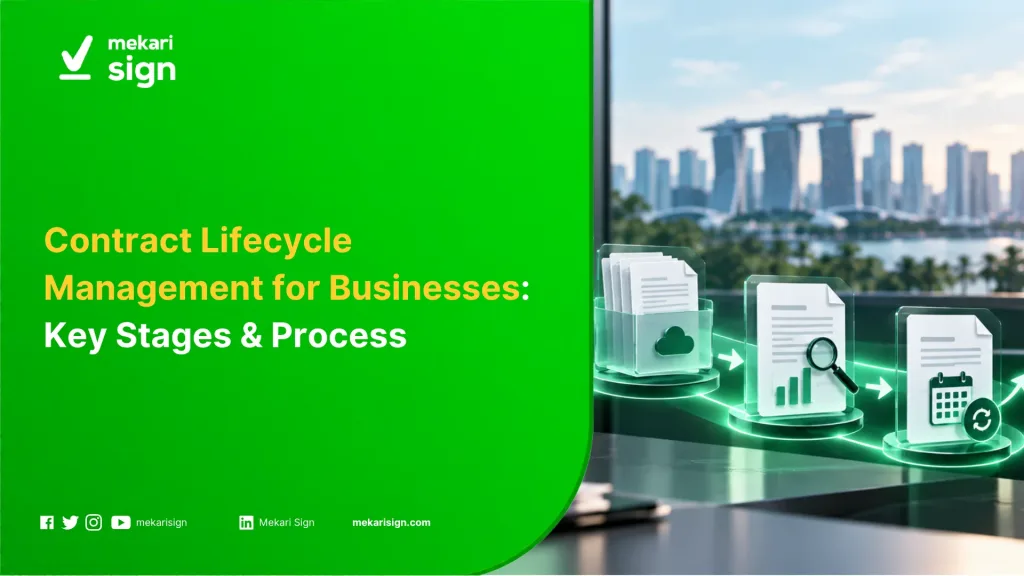
- Contract lifecycle management (CLM) covers the process of creating, reviewing, approving, signing, managing, and renewing or closing business contracts.
- The number of CLM stages can vary between frameworks because some activities are grouped together. The underlying process remains similar.
- Different teams can own different stages, so contract ownership, approval authority, and handoffs need to be defined before the workflow is automated.
- CLM software connects contract intake, templates, approvals, electronic signing, document storage, contract tracking, and renewal management.
- For businesses in Singapore, Mekari Sign connects contract management, approval, electronic signing, and contract tracking in one digital workflow.
A contract goes through several steps before it becomes an active business agreement. A team identifies the need, prepares the document, reviews the terms, obtains internal approval, and completes the signing process.
The work continues after execution. Teams may need to monitor obligations, payment terms, contract dates, performance, amendments, and renewal decisions throughout the agreement. Contract lifecycle management gives these activities a defined process and record.
What Is Contract Lifecycle Management?
Contract lifecycle management (CLM) is the process of managing a contract across its different stages, from the initial request and drafting through approval, execution, post-signature management, and renewal or closure.
CLM can refer to the operating process, the technology supporting that process, or both. A CLM system can connect contract requests, templates, reviews, approvals, electronic signatures, storage, tracking, and renewal activities within the same workflow.
The number of stages depends on how an organisation groups related activities. World Commerce & Contracting (WorldCC), for example, structures contract management around three broad phases: pre-award, award, and post-award. More detailed CLM workflows divide these phases into activities such as drafting, negotiation, approval, execution, performance management, and renewal. WorldCC’s Contract Management Standard provides a recognised framework for these lifecycle phases.
The scope of CLM therefore extends beyond getting a contract signed. The agreement still needs an owner, a record of its terms, follow-up on obligations, and a plan for what happens when the contract approaches its next decision point.
What Are the Stages of the Contract Lifecycle?
A practical CLM workflow can be divided into eight stages. Organisations may combine some of them depending on their contract types and internal processes.
| Stage | What happens | Common output |
|---|---|---|
| 1. Contract request | The business identifies the need for an agreement and provides the information required to start the process. | Contract request and business requirements |
| 2. Drafting | The agreement is prepared using an approved template or a new draft. | Initial contract draft |
| 3. Review and negotiation | Legal and business stakeholders review the terms and negotiate changes with the other party. | Agreed contract terms |
| 4. Approval | The contract follows the required internal approval route based on factors such as value, risk, contract type, or authority level. | Recorded approval decision |
| 5. Execution | The authorised parties sign the approved agreement using an appropriate signing method. | Executed contract |
| 6. Storage and record management | The executed agreement and relevant contract information are stored for authorised access. | Complete contract record |
| 7. Obligation and performance monitoring | The responsible teams monitor deliverables, payments, service levels, reporting requirements, and other commitments. | Performance and obligation records |
| 8. Renewal, amendment, or termination | The contract owner reviews the agreement and decides what should happen before expiry or a notice deadline. | Renewal, amendment, replacement, or termination decision |
WorldCC’s lifecycle framework also includes activities before and after contract award, including contract development, negotiation, implementation, performance, and closure. This is why a contract lifecycle extends beyond the signing event.
Who Is Responsible for Each Stage of the Contract Lifecycle?
Contract ownership often moves between functions as an agreement progresses. Legal may manage contractual review, Procurement may handle supplier negotiations, Finance may check commercial terms, and the business owner may monitor performance after execution.
| Function | Typical responsibilities |
|---|---|
| Legal | Contract terms, legal review, clause standards, exceptions, and contractual risk |
| Procurement | Supplier agreements, commercial terms, negotiation, and supplier performance |
| Finance | Payment terms, financial commitments, invoices, and commercial checks |
| HR | Employment agreements and related employee documentation |
| Business owner | Business requirements, contract performance, and renewal decisions |
| IT / Legal Operations | Access control, workflow configuration, integrations, reporting, and contract data |
The same contract can involve several owners at different points. For example, Procurement may initiate and negotiate a supplier agreement, Legal may approve material changes, and the business owner may take responsibility for performance once the contract is active.
Defining ownership before implementation also makes it easier to set approval rules and determine who should receive reminders for upcoming contract dates.
What Is the Difference Between CLM, Contract Management, DMS, and eSignature?
These terms are related, but they describe different parts of contract operations.
| Term | Main focus | Role in the contract lifecycle |
|---|---|---|
| Contract Lifecycle Management (CLM) | Managing the contract across its lifecycle | Connects the activities from request through renewal or closure |
| Contract Management | Managing agreements, obligations, performance, and contractual records | Covers the ongoing management of the agreement |
| Document Management System (DMS) | Storing, organising, securing, and retrieving documents | Supports document and record control |
| Electronic Signature | Executing an agreement electronically | Usually forms part of the execution stage |
The boundaries can vary by organisation and software provider. A company may use a DMS to store contracts and a separate electronic signature service to execute them, while a CLM platform can connect those activities into one contract workflow.
For Singapore businesses, IMDA states that electronic signatures are supported under Singapore law and can be used for almost all agreements commonly used in functions such as sales, procurement, HR, and finance, subject to the applicable requirements and exclusions. IMDA’s guide to adopting electronic signature solutions also outlines factors businesses should consider when selecting an electronic signing method.
Read more: Electronic Signature vs Digital Signature in Singapore: What’s the Difference?
What Features Should a Contract Lifecycle Management System Include?
The right feature set depends on the organisation’s contract volume, approval structure, contract types, and existing systems. The following capabilities cover the main workflow.
| Capability | What it supports |
|---|---|
| Contract intake | Collect required information and start the appropriate workflow |
| Templates and custom fields | Create recurring contracts using approved structures and reusable information |
| Review and approval workflows | Route contracts to the required reviewers and approvers before signing |
| Electronic signing | Send approved contracts to authorised signers and record execution activity |
| Contract repository | Keep executed agreements and related information in an accessible record |
| Contract tracking | Track active agreements, expiry dates, and contract status |
| Renewal reminders | Alert contract owners before renewal and notice deadlines |
| Audit trail | Record activities and approval history for later review |
| Integrations | Connect contract workflows with CRM, ERP, procurement, HR, and other business systems |
| AI assistance | Support document summarisation, term extraction, clause identification, and version comparison |
A CLM system does not need to make every contractual decision automatically. Routine actions can follow predefined rules, while negotiation, legal interpretation, and acceptance of contractual risk still depend on the responsible people.
How Does Contract Lifecycle Management Work in Practice?
Consider a supplier agreement for a Singapore-based company.
- Procurement submits the request. The request includes supplier information, contract type, commercial requirements, and relevant dates.
- The contract is prepared. The team starts from an approved template when the agreement follows a recurring pattern.
- Legal and business stakeholders review the agreement. Changes are discussed with the supplier until both parties agree on the terms.
- The contract goes through approval. The workflow sends the agreement to the required approvers based on internal rules.
- The approved agreement is signed. The authorised parties complete the electronic signing process where the transaction and signing method permit it.
- The executed agreement is stored. The final document remains attached to its contract record.
- The contract is monitored. Procurement, Finance, and the business owner track the obligations relevant to their roles.
- The owner reviews the next decision. Before expiry or a notice deadline, the business decides whether to renew, renegotiate, amend, replace, or terminate the agreement.
Singapore’s Ministry of Finance follows a similar post-award principle for government procurement: contract management includes checking delivery against contractual requirements, monitoring costs, maintaining documentation, and dealing with potential contractual issues. The Ministry of Finance procurement process provides the relevant example.
The workflow moves the agreement from one stage to the next, while the people responsible for the contract continue to make the decisions that affect its commercial and legal outcome.
What Are the Benefits of Contract Lifecycle Management?
| Benefit | What changes in the process |
|---|---|
| Better contract visibility | Teams can see the current stage, contract status, owner, and upcoming dates. |
| Fewer missed deadlines | Expiry and notice dates can be linked to contract records and automated reminders. |
| More consistent workflows | Recurring agreements can use approved templates, review routes, and approval rules. |
| Less manual coordination | Routine routing, notifications, filing, and status updates can follow predefined rules. |
| Clearer accountability | Each agreement has defined owners for approval, execution, performance, and renewal decisions. |
| Better contract records | The executed agreement, approval history, and relevant contract information can remain connected. |
These benefits become more relevant as contract volume grows or several departments share responsibility for the same agreements. The value comes from having a defined process and accessible contract information rather than from automation alone.
Read more: Enterprise Contract Management Strategy
How Can a Business Start Implementing CLM?
A business does not need to move every contract type into a CLM workflow at the same time. Start with agreements that occur frequently and follow a process that the organisation can describe clearly.
- Map the current workflow. Document how contracts are requested, drafted, reviewed, approved, signed, stored, and monitored.
- Define ownership. Assign responsibility for each contract type and identify who approves exceptions.
- Standardise recurring agreements. Identify approved templates, required fields, standard clauses, and approval routes.
- Separate rules from decisions. Determine which actions can follow fixed conditions and which require human review.
- Connect the workflow. Bring preparation, approval, signing, storage, tracking, and renewal reminders into the same process where practical.
- Measure the baseline. Track contract cycle time, approval waiting time, manual handoffs, and missed deadlines before changing the workflow.
Starting with a repeatable contract also makes it easier to test the workflow before introducing more complex agreements with unusual terms or higher levels of risk.
How Is AI Changing Contract Lifecycle Management?
AI is becoming part of contract workflows through tasks that involve reading, comparing, or extracting information from contract documents.
| Task | How AI can help | Human role |
|---|---|---|
| Contract summarisation | Produce a short summary of a long agreement | Check the summary against the contract |
| Term extraction | Identify dates, parties, amounts, or other contract information | Verify the extracted information |
| Clause identification | Locate clauses that match a defined category | Interpret the clause and determine its relevance |
| Version comparison | Highlight differences between contract versions | Assess the business and legal impact of changes |
| Workflow automation | Trigger predefined actions based on structured contract information | Handle exceptions and decisions outside the defined rules |
UNCITRAL adopted its Model Law on Automated Contracting in 2024. The model law addresses legal recognition of automation and AI in the formation and performance of contracts, while also recognising that automated contracting remains subject to applicable legal requirements. UNCITRAL’s Model Law on Automated Contracting provides the international framework.
For CLM, the practical role of AI is therefore focused on supporting document work and information handling. The organisation still needs rules that determine when a human must review a contract or make a decision.
Read more: Contract Management Automation: Your Guide for Business Teams
How Does Mekari Sign Support the Contract Lifecycle?
Mekari Sign brings several contract workflow stages into one platform. Its current CLM offering covers contract creation, reusable templates, multi-stage approval, electronic signing, central contract storage, status tracking, and renewal or expiry alerts.
For businesses that need these activities connected, Mekari Sign’s contract lifecycle management software provides a workflow for preparing contracts, obtaining approvals, executing agreements, storing the completed records, and following contract status through renewal.
The platform also connects with the wider Mekari Sign feature set, including Contract Management, Contract Analytics, approval workflows, reusable templates, contract reminders, and AI assistance.
For organisations managing contracts across multiple teams or entities, the next step is to define how contract ownership, approval rules, local requirements, automation, and business systems should work together.